
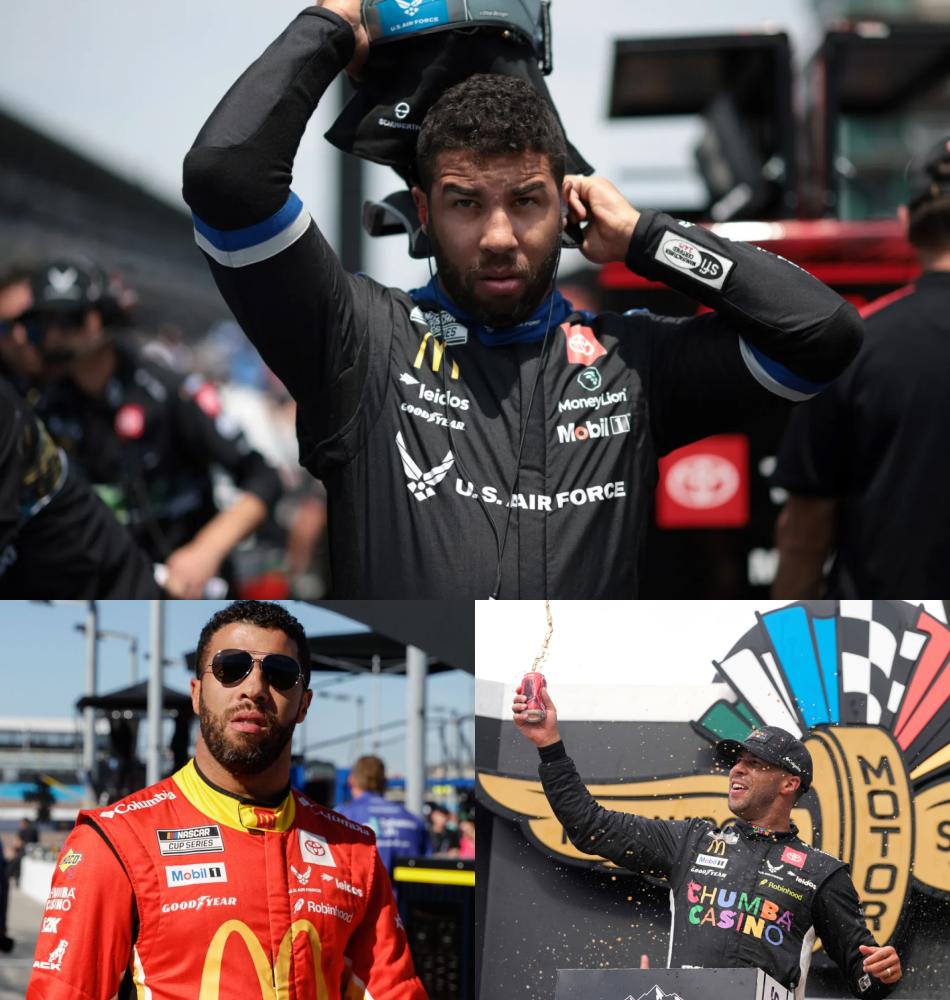
Bubba Wallace Boldly Claims: “If I Quit Racing, NASCAR’s Viewership Would Plunge by As Much As 60%!”
In a fiery and confident statement that’s sure to ignite further discussion, Bubba Wallace has claimed that his departure from NASCAR could cause the sport’s viewership to drop by as much as 60%. The bold assertion from Wallace, who has become one of the sport’s most prominent figures in recent years, is raising eyebrows and fueling a wave of debate within NASCAR circles and beyond.
Wallace, who made history as the first African American driver to win a NASCAR Cup Series race in over 50 years, has been an influential figure both on and off the track. His presence in NASCAR has been a source of immense attention, not only due to his racing skills but also because of his advocacy for diversity and social change in the sport.
The Bold Claim: Bubba’s Impact on NASCAR’s Popularity
Speaking to the media after a recent race, Bubba Wallace made his case clear: “If I quit racing tomorrow, I think you’d see NASCAR’s viewership drop by 60%,” he said, emphasizing his pivotal role in drawing new fans to the sport. Wallace has been a key figure in attracting a younger, more diverse audience to NASCAR, often leading discussions around inclusivity and pushing for a more progressive future within the motorsport world.
“I’m not just talking about racing fans—I’m talking about the broader fanbase that follows what I’m doing on social media, who watches NASCAR because they see me challenging the status quo,” Wallace added. “I bring something to this sport that resonates with a generation that NASCAR has been working hard to connect with.”
A New Generation, A New Focus
Bubba Wallace’s rise in NASCAR coincides with the sport’s larger effort to appeal to a younger, more diverse fanbase. With the sport’s traditional audience largely skewing older and predominantly white, Wallace’s prominence has been part of NASCAR’s strategy to evolve and diversify.
The 29-year-old driver’s advocacy on issues like racial equality, his vocal support for the Black Lives Matter movement, and his commitment to challenging the sport’s norms have made him a lightning rod for both support and criticism. But regardless of the polarized opinions, Wallace’s presence has undeniably made waves in the motorsport world, bringing NASCAR to the forefront of broader cultural conversations.
NASCAR’s Changing Landscape
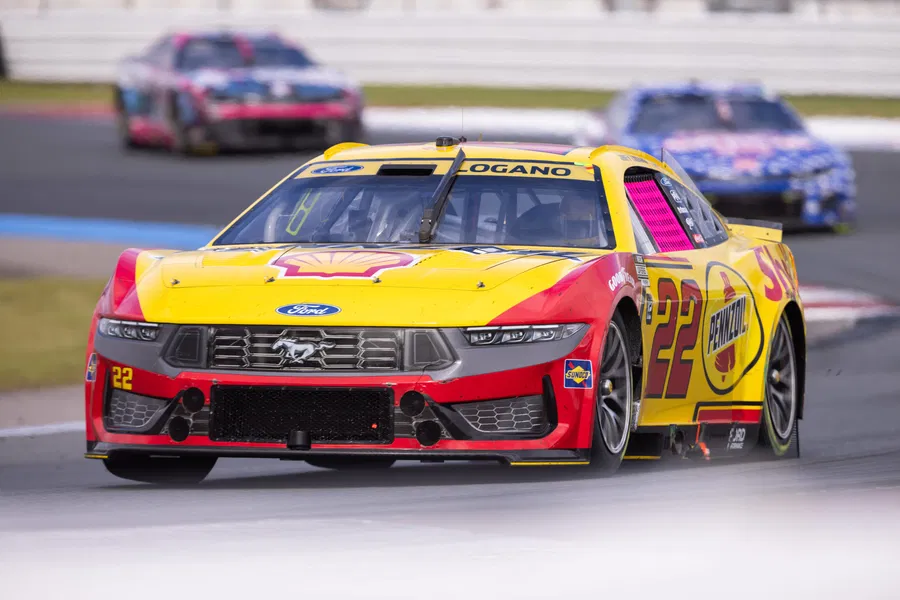
While Wallace’s claim might seem hyperbolic to some, the statistics do indicate a shift in viewership patterns. Recent reports show that NASCAR’s fanbase is indeed diversifying, with younger and more racially diverse viewers tuning in, many of whom are drawn to the sport through drivers like Wallace. His role as a trailblazer in NASCAR, a sport often criticized for being slow to embrace change, has sparked more interest than ever before.
For Wallace, his success both on and off the track has made him a household name, and his influence extends well beyond racing circles. Whether or not his claim holds up under closer scrutiny, it’s undeniable that Wallace’s impact on NASCAR has been substantial—especially in terms of making the sport more inclusive and appealing to a broader audience.
A Controversial Statement, But Why It Matters
Bubba Wallace’s claim, while bold, raises a fundamental question about the role of athletes as cultural figures. Are they simply competitors, or do they hold the power to shape entire industries and bring in viewers who may otherwise not be interested? Wallace believes his influence stretches far beyond just his lap times and pit stops—and it’s a perspective that’s hard to ignore, given the profound effect he’s had on NASCAR’s evolution.
In the coming years, NASCAR will undoubtedly continue to navigate its identity, audience, and the role of diversity in its future. Bubba Wallace, with his unflinching confidence and willingness to speak out on matters of race and culture, will remain a key figure in that conversation—whether his viewership claim proves accurate or not.
As for NASCAR fans, one thing’s clear: the sport is in the midst of a transformative era, and Bubba Wallace is at the heart of it.